

About this car
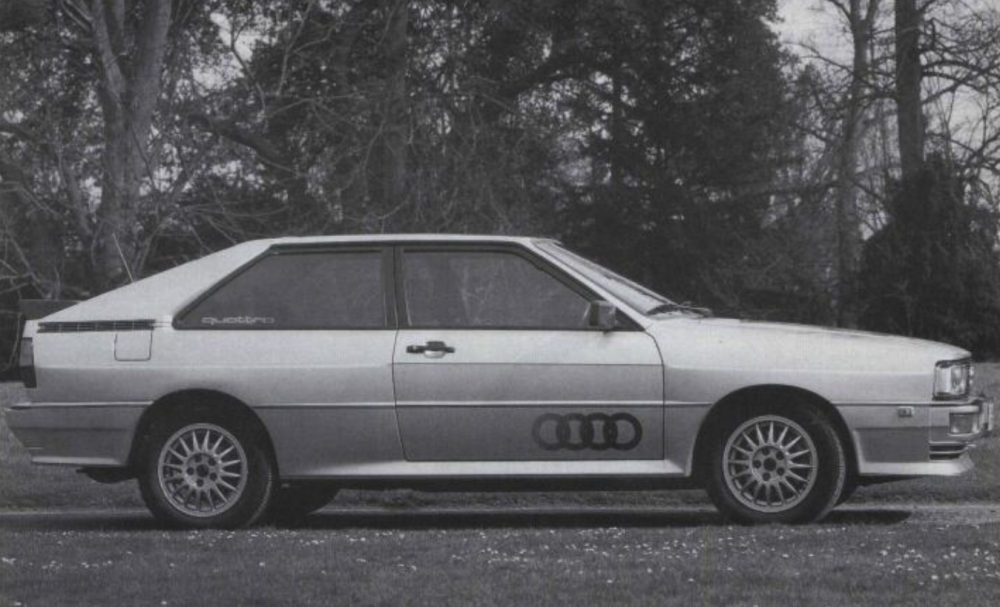
The Audi Quattro emerges as Europe’s first series-produced car with all-wheel drive, setting a significant precedent in automotive history. Though not entirely original, preceding attempts by Jensen and Subaru were limited in scale and visibility.
Origins and Development: The Visionaries Behind Audi Quattro
Conceptualized in the late ’70s by visionary chassis engineer Jörg Bensinger, Audi’s focus on addressing the limitations of front-wheel-drive vehicles led to the exploration of all-wheel drive technology. Supervised by Ferdinand Piëch, the project aimed to enhance vehicle maneuverability, traction, and overall safety.
Engineering Marvel: Design and Performance
Based on the Audi 80 GT platform, the Quattro introduced four-wheel drive coupled with three differentials to manage power distribution effectively. Powered by a robust 2.1-liter turbocharged 5-cylinder engine, generating 200 hp and 285 Nm torque, it achieved impressive performance metrics – reaching speeds of 220 km/h and accelerating from 0 to 100 km/h in 7.1 seconds.
Debut and Triumph: Audi Quattro’s Rise to Prominence
Unveiled at the 1980 Geneva Motor Show, the Audi Quattro’s aggressive design and formidable performance captured the automotive world’s attention, solidifying its status as an icon. Its participation in the World Rally Championship from its inception further underscored its capabilities, competing fiercely against established rivals like Ford, Lancia, and Peugeot.
Name Origin and Significance: Innovating Tradition
Inspired by the Audi 80’s exceptional performance on challenging terrains, the decision to incorporate the same all-wheel-drive system into a sportier variant paid dividends. The Quattro’s name, derived from the Italian word for “four,” symbolized its pioneering all-wheel-drive technology and its capability to redefine driving experiences.
Legacy and Influence: Shaping the Future of Automotive Engineering
The Audi Quattro’s widespread acclaim and adoption underscored its pivotal role in revolutionizing the automotive landscape. Its innovative technology, combined with exceptional performance, ensured its enduring legacy and cemented Audi’s reputation as a trailblazer in engineering excellence.
Trim Levels/Versions
5| Year | Model Name | Fuel | Body | WheelDrive | Pr.From | to | Speed | QOD | |
|---|---|---|---|---|---|---|---|---|---|
| Year | Model Name | Fuel | Body | WheelDrive | Pr.From | to | Speed | QOD | |
| 1980 | 1980 Audi Quattro | Petrol | Coupé | AWD | 0 | 0 | - |
E
|
|
| 1983 | 1983 Audi Sport Quattro | Petrol | Coupé | AWD | 0 | 0 | 250 km/h | 1 |
E
|
| 1987 | Audi Coupé quattro | Petrol | Coupé | AWD | 0 | 0 | 202 km/h |
E
|
|
| 1987 | 1987 Audi Quattro | Petrol | Coupé | AWD | 0 | 0 | 222 km/h |
E
|
|
| 1990 | 1990 Audi Quattro 20v | Petrol | Coupé | AWD | 0 | 0 | 227 km/h |
E
|
Engines
5| Id.Engine | 2133 cc | 2144 cc | 2226 cc | 2226 cc | 2226 cc |
|---|---|---|---|---|---|
| Kind of Engine | Turbocharged | Turbocharged | Naturally aspirated | Turbocharged | |
| Identificative engine | |||||
| Cylinders Configuration | Straight/Inline Engine | Straight/Inline Engine | Straight/Inline Engine | Straight/Inline Engine | Straight/Inline Engine |
| Displacement | 2133 cc | 2144 cc | 2226 cc | 2226 cc | 2226 cc |
| Cylinders number | 5 | 5 | 5 | 5 | 5 |
| Fuel | Petrol | Petrol | Petrol | Petrol | Petrol |
| Electric engine - kind | |||||
| Battery kind | |||||
| Peak Power (hp) | |||||
| Peak Power (kW) | |||||
| Battery power | |||||
| Operating Voltage | |||||
| Battery: Operating Temperature | |||||
| Battery: System Voltage | |||||
| Battery: Cell Configuration | |||||
| Battery: 0-80% Charge time | |||||
| Torque | 330 N-m | 285 N-m | 186 N-m | 270 N-m | 315 N-m |
| Torque @ r.p.m. | 4500 rpm | 3500 rpm | 3500 rpm | 3000 rpm | 2100 rpm |
| Cylinders angle | |||||
| Maximum Power (HP) | 301.5 hp | 197 hp | 134 hp | 197 hp | |
| Power (PS) | 306 ps | 200 ps | 136 ps | 200 ps | 220 ps |
| Power kW | 225 kW | 147 kW | 100 kW | 147 kW | |
| Power @ rounds per minute | 6500 rpm | 5500 rpm | 5700 rpm | 5800 rpm | 5900 rpm |
| Bore | 79.3 mm | 79.5 mm | 81 mm | 81 mm | |
| Stroke | 86.4 mm | 86.4 mm | 86.4 mm | 86.4 mm | |
| Valve Train | Double overhead camshaft DOHC | Double overhead camshaft DOHC | Single overhead camshaft SOHC | Single overhead camshaft SOHC | |
| Compression Ratio | 8:1 | 7:1 | 10:1 | 8.6:1 | 9 |
| Engine block material | |||||
| Cylinder head material | |||||
| Fuel System | bosch hi-jetronic fuel injection | bosch k-jetronic fuel injection | bosch ke-jetronic fuel injection | bosch k-jetronic fuel injection | |
| Coolant | Water | Water | Water | Water | |
| Engine Data accuracy | |||||
|
Sport Quattro
1
|
Quattro
1
|
Coupé quattro
1
|
Quattro
1
|
Quattro 20v
1
|
Car body variants
1 COU| Variants | #COU | #COU | #COU | #COU | #COU |
|---|---|---|---|---|---|
| Body style | Coupé | Coupé | Coupé | Coupé | Coupé |
| no.Doors | |||||
| Wheelbase | 2200 mm | 2522 mm | 2522 mm | 2525 mm | 2525 mm |
| Lenght | 4160 mm | 4404 mm | 4404 mm | 4405 mm | 4421 mm |
| Width | 1800 mm | 1722 mm | 1722 mm | 1725 mm | 1682 mm |
| Height | 1340 mm | 1344 mm | 1346 mm | 1345 mm | 1376 mm |
| Curb Weight | |||||
| Wheel Drive | |||||
| Engine Location | Front | Front | Front | Front | Front |
| Chassis | |||||
| Seating capacity (number) | |||||
| Track Tread (front) | 1520 mm | 1461 mm | 1421 mm | 1460 mm | 1403 mm |
| Track Tread (rear) | 1490 mm | 1494 mm | 1451 mm | 1495 mm | 1424 mm |
| Luggage capacity (min) | |||||
| Luggage capacity (max) | |||||
| Weight distribution (FRONT) | |||||
| Engine Alignment | Longitudinal | Longitudinal | Longitudinal | Longitudinal | Longitudinal |
| Drag Coefficient | |||||
| Equipment | |||||
|
Sport Quattro
|
Quattro 20v
|
Quattro
|
Quattro
|
Coupé quattro
|
Linked Cars
Assembly site(s)
Sales figures
Gallery


You may like
AC 2-Litre (1949)
Acura Integra GS-R (1998)
Adams 10/12
Adler 10