

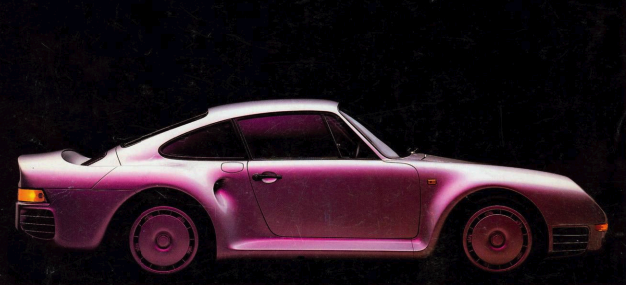
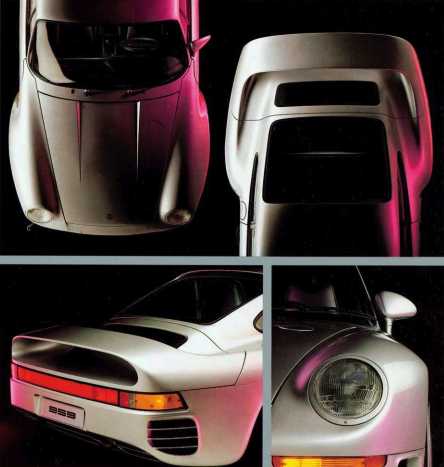
About this car
In 1986 the Porsche 959 was not simply the fastest and most technologically advanced road car in the world — it was a laboratory. Porsche did not design it just to win headlines or Group B homologation. The real goal was to solve a problem that had limited high-performance cars for decades:
Supercars of the early 1980s were powerful but inefficient in real conditions. Most were rear-wheel drive. On dry pavement they were quick; on wet roads they were intimidating; on snow or broken tarmac they became almost uncontrollable. Tire technology and mechanical limited-slip differentials were reaching their limits.
The 959 introduced the first truly intelligent all-wheel-drive system ever fitted to a production car — a system Porsche called PSK (Porsche-Steuer Kupplung), meaning electronically controlled clutch.
Today traction control, torque vectoring, and stability management are normal. In 1986 they practically did not exist. The 959 was one of the very first cars to use a computer not just for engine management, but to actively control how the car put power on the road.
The PSK system continuously monitored:
- wheel speeds
- throttle position
- steering input
- vehicle acceleration
- load transfer (weight shifting during braking or acceleration)
Instead of a fixed mechanical differential, the 959 used a multi-plate clutch controlled by hydraulics and electronics to distribute torque between the front and rear axles. The car could change its drivetrain layout while you were driving.
Under normal driving conditions the system maintained a slightly rear-biased character, sending roughly forty percent of the torque to the front axle and sixty percent to the rear. When the driver accelerated hard, the control unit shifted the balance even further toward the rear wheels, allowing as much as eighty percent of the engine’s power to be delivered there for maximum traction and performance. On slippery surfaces, however, the logic worked in the opposite direction, progressively transferring more torque to the front axle in order to stabilise the car and prevent loss of grip.
This approach was revolutionary for its time. Earlier all-wheel-drive layouts, such as those used in traditional off-road vehicles, were either permanently locked or manually engaged by the driver. The 959 instead analysed available grip in real time and reacted before noticeable wheelspin occurred.
The drivetrain was also integrated with an advanced anti-lock braking system. Each wheel was equipped with its own speed sensor, and the braking control unit continuously exchanged information with the drivetrain controller. If a wheel began to slip, the system could intervene immediately, coordinating braking and torque distribution. The selectable driving programmes found in modern performance cars trace their origins directly back to this concept.
Trim Levels/Versions
3| Year | Model Name | Fuel | Body | WheelDrive | Pr.From | to | Speed | QOD | |
|---|---|---|---|---|---|---|---|---|---|
| Year | Model Name | Fuel | Body | WheelDrive | Pr.From | to | Speed | QOD | |
| 1985 | Porsche 959 Dakar | Petrol | Coupé | AWD | 0 | 0 | - |
E
|
|
| 1985 | Porsche 959 Sport | Petrol | Coupé | AWD | 0 | 0 | 315 km/h |
E
|
|
| 1986 | Porsche 959 | Petrol | Coupé | UNK | 0 | 0 | 300 km/h |
D
|
Engines
2| Id.Engine | 2849 cc | 2849 cc |
|---|---|---|
| Kind of Engine | Internal Combustion Engine | Turbocharged |
| Identificative engine | 959.50 | |
| Cylinders Configuration | Boxer/Flat Engine | Boxer/Flat Engine |
| Displacement | 2849 cc | 2849 cc |
| Cylinders number | 6 | 6 |
| Fuel | Petrol | Petrol |
| Electric engine - kind | ||
| Battery kind | ||
| Peak Power (hp) | ||
| Peak Power (kW) | ||
| Battery power | ||
| Operating Voltage | ||
| Battery: Operating Temperature | ||
| Battery: System Voltage | ||
| Battery: Cell Configuration | ||
| Battery: 0-80% Charge time | ||
| Torque | 500 N-m | 500 N-m |
| Torque @ r.p.m. | 5000 rpm | |
| Cylinders angle | ||
| Maximum Power (HP) | 400 hp | 444.3 hp |
| Power (PS) | 450 ps | |
| Power kW | 331 kW | |
| Power @ rounds per minute | 6500 rpm | 6500 rpm |
| Bore | 95 mm | |
| Stroke | 67 mm | |
| Valve Train | Double overhead camshaft DOHC | |
| Compression Ratio | 8.3:1 | |
| Engine block material | ||
| Cylinder head material | ||
| Fuel System | bosch motronic fuel injection | |
| Coolant | Water | |
| Engine Data accuracy | ||
|
959 Dakar
4
959 Sport 4 |
959
1
|
Car body variants
1 COU| Variants | #COU |
|---|---|
| Body style | Coupé |
| no.Doors | |
| Wheelbase | 2300 mm |
| Lenght | 4260 mm |
| Width | 1840 mm |
| Height | 1280 mm |
| Curb Weight | |
| Wheel Drive | |
| Engine Location | Rear |
| Chassis | |
| Seating capacity (number) | |
| Track Tread (front) | 1504 mm |
| Track Tread (rear) | 1550 mm |
| Luggage capacity (min) | |
| Luggage capacity (max) | |
| Weight distribution (FRONT) | |
| Engine Alignment | Longitudinal |
| Drag Coefficient | |
| Equipment | |
|
959 Dakar
959 Sport 959 |
Linked Cars
Assembly site(s)
Sales figures
Gallery
Scale models
 DiecastLovers - Official site of diecast addicted.
You may like
Austin A 40 Dorset (1950)
Austin-Healey 100 Six (1958)
Austro-Daimler ADM 19/100 (1928)
grouped under: IATO IatoAutobianchi Primula (1964)
grouped under: Autobianchi Primula