

About this car
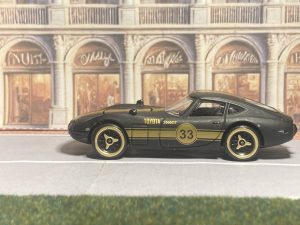
In 1967, Toyota showcased its remarkable engineering prowess and design expertise by unveiling what is now celebrated as one of the most extraordinary, rare, and iconic Japanese automobiles of all time: the Toyota 2000 GT. This elegant two-seater coupe was not only extraordinary to drive and technologically advanced for its era but also served as a powerful statement of Toyota’s resurgence in the global automotive arena, challenging the dominance of European and American manufacturers.
Following the aftermath of World War II, victorious nations like the United Kingdom and the United States often ridiculed Japanese automakers, derisively referring to Toyota as “ToyMotor” to suggest their vehicles were mere toys compared to Western sports cars. Yet, such derision proved fleeting.
The genesis of the 2000 GT stemmed from a sports coupe project originally conceptualized by Yamaha and abandoned by Nissan. Toyota seized the opportunity, recognizing the potential to produce a vehicle capable of competing with—and even surpassing—iconic contemporaries such as the Jaguar E-Type and the Porsche 911. Under the guidance of project leader Shoichi Saito, Toyota’s most accomplished engineers, testers, and designers worked with unyielding determination. Saito’s directive was unequivocal: “Do whatever it takes not only to build the Toyota 2000 GT, but to make it one of the greatest cars in the world, if not the greatest.”
The 1965 Tokyo Motor Show marked the public debut of this front-engine, rear-wheel-drive masterpiece, captivating audiences with its breathtaking design, balanced proportions, and cutting-edge performance. By the time production commenced in 1967, the 2000 GT had silenced its critics. It featured independent suspension, disc brakes on all four wheels, a limited-slip differential, a lightweight aluminum body, magnesium wheels, and a refined engine developed in collaboration with Yamaha.
While its design exhibited clear influences from European sports cars—particularly the long hood, set-back cabin, and fluid rear silhouette reminiscent of the Jaguar E-Type Coupe and elements echoing Ferrari Berlinetta styling—the majority of the car’s design was attributed to Satoru Nozaki.
Adding to its legendary status, the Toyota 2000 GT cemented its cultural significance by appearing in the 1967 James Bond film You Only Live Twice, where it was specially modified into a convertible to accommodate actor Sean Connery. This role not only highlighted the car’s beauty and sophistication on the global stage but also solidified its position as an enduring symbol of Japanese automotive achievement.
Trim Levels/Versions
2| Year | Model Name | Fuel | Body | WheelDrive | Pr.From | to | Speed | QOD | |
|---|---|---|---|---|---|---|---|---|---|
| Year | Model Name | Fuel | Body | WheelDrive | Pr.From | to | Speed | QOD | |
| 1968 | 1968 Toyota 2000 GT MF10 | Petrol | Coupé | UNK | 0 | 0 | 220 km/h | 1 |
|
| 1968 | 1968 Toyota 2000 GT Open-Top | Petrol | Convertible/Cabrio/Cabriolet | UNK | 0 | 0 | 220 km/h | 1 |
|
Engines
1| Id.Engine | 1988 cc |
|---|---|
| Kind of Engine | Naturally aspirated |
| Identificative engine | 3m |
| Cylinders Configuration | Straight/Inline Engine |
| Displacement | 1988 cc |
| Cylinders number | 6 |
| Fuel | Petrol |
| Electric engine - kind | |
| Battery kind | |
| Peak Power (hp) | |
| Peak Power (kW) | |
| Battery power | |
| Operating Voltage | |
| Battery: Operating Temperature | |
| Battery: System Voltage | |
| Battery: Cell Configuration | |
| Battery: 0-80% Charge time | |
| Torque | |
| Torque @ r.p.m. | |
| Cylinders angle | |
| Maximum Power (HP) | 148 hp |
| Power (PS) | 150 ps |
| Power kW | 110 kW |
| Power @ rounds per minute | 6600 rpm |
| Bore | 75 mm |
| Stroke | 75 mm |
| Valve Train | Double overhead camshaft DOHC |
| Compression Ratio | 8.4:1 |
| Engine block material | |
| Cylinder head material | |
| Fuel System | 3 mikuni-solex carburettors |
| Coolant | Water |
| Engine Data accuracy | |
|
2000 GT MF10
1
2000 GT Open-Top 5 |
Car body variants
2 COU CVT| Variants | #COU | #CVT |
|---|---|---|
| Body style | Coupé | Convertible/Cabrio/Cabriolet |
| no.Doors | ||
| Wheelbase | 2329 mm | 2329 mm |
| Lenght | 4176 mm | 4176 mm |
| Width | 1600 mm | 1600 mm |
| Height | 1161 mm | 1161 mm |
| Curb Weight | ||
| Wheel Drive | ||
| Engine Location | Front | Front |
| Chassis | ||
| Seating capacity (number) | ||
| Track Tread (front) | 1300 mm | 1300 mm |
| Track Tread (rear) | 1300 mm | 1300 mm |
| Luggage capacity (min) | ||
| Luggage capacity (max) | ||
| Weight distribution (FRONT) | ||
| Engine Alignment | Longitudinal | Longitudinal |
| Drag Coefficient | ||
| Equipment | ||
|
2000 GT MF10
|
2000 GT Open-Top
|
Linked Cars
Assembly site(s)
Sales figures
Gallery


You may like
Argus 45-50 hp
Argyll 12/18
1925 Armstrong Siddeley 18 Mk II
1912 Arrol-Johnston 15.9